Written by
Ethan Reeves
Publish Date
Category
Video Marketing Tips
Let’s keep this real. A “$10K day” doesn’t come from hype it comes from math.
Revenue = Price × Orders, and Orders = Impressions × CTR × CVR. Your VSL’s job is to lift those levers without breaking trust.
Here’s what a $10K day actually looks like:
$97 offer → 104 orders → at ~6% CTR and ~5% page CVR you need ~34.7k impressions.
$297 offer → 34 orders → at ~6% CTR and ~6% page CVR you need ~9.4k impressions.
$997 offer → 11 orders → at ~3% CTR and ~3% page CVR you need ~12.2k impressions.
No hype, just targets. Your cold open should set this tone: We’re not guessing. We’re aiming.
Then nudge the reader into the plan: the script that lifts CTR (hook + relevance), the proof and clarity that lift CVR, and the pricing/bonuses that make Price × Orders land at $10K.
The Offer Math: Three viable paths ($97 / $297 / $997)
If your goal is $10K in 24 hours, the math is straightforward.
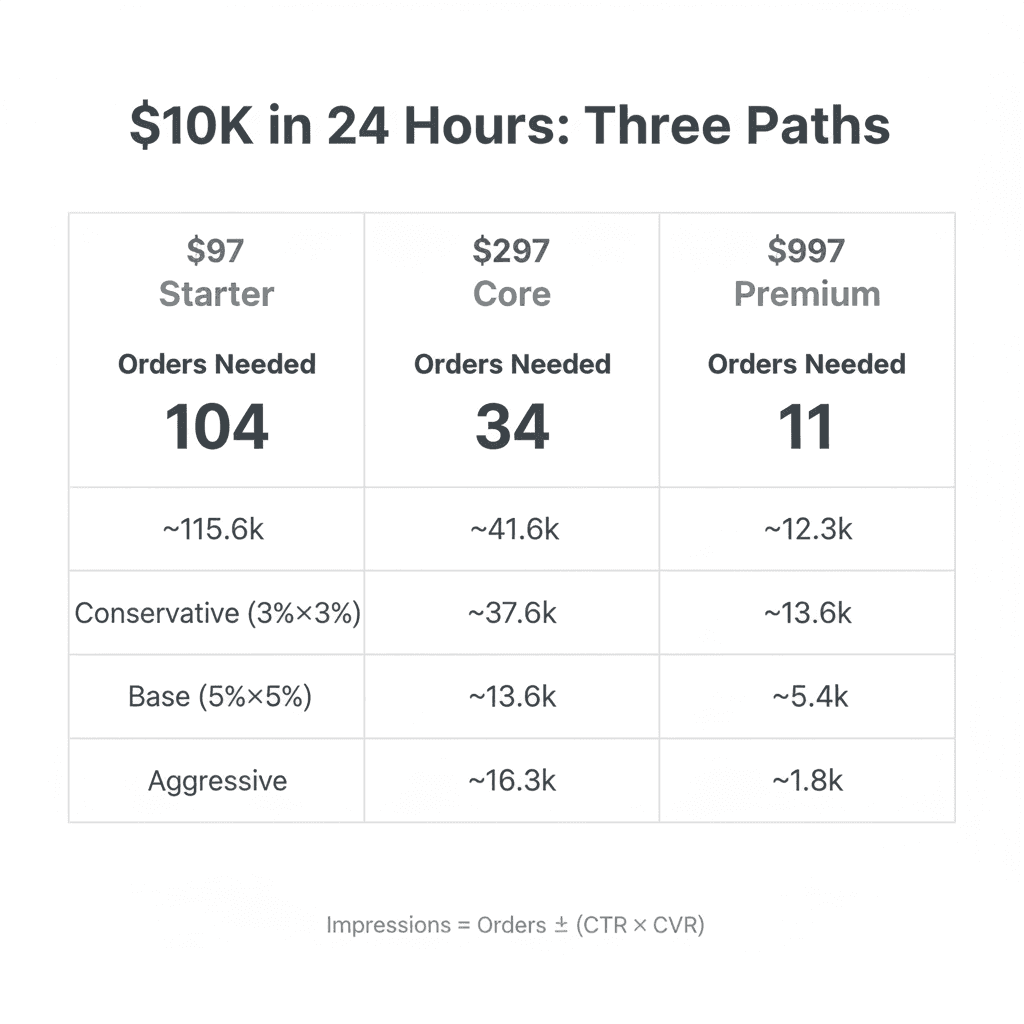
Orders needed = $10,000 ÷ Price → then back into Impressions = Orders ÷ (CTR × CVR).
Below are three realistic pricing paths you can choose from, with conservative/base/aggressive assumptions for click-through (CTR) and page conversion (CVR).
Use this to position yourself as a Talking head video editing agency building high-converting videos—it’s clear, measurable, and feels trustworthy to readers.
Path A — $97 “starter” offer
Orders needed: 104
Impressions required:
Conservative (CTR 3%, CVR 3%): ~115.6k
Base (CTR 5%, CVR 5%): ~41.6k
Aggressive (CTR 8%, CVR 8%): ~16.3k
Path B — $297 “core” offer
Orders needed: 34
Impressions required:
Conservative (3% × 3%): ~37.8k
Base (5% × 5%): ~13.6k
Aggressive (8% × 8%): ~5.4k
Path C — $997 “premium” offer
Orders needed: 11
Impressions required:
Conservative (3% × 3%) = 12.3k
Base (5% × 5%) = 4.4k
Aggressive (8% × 8%) = 1.8k
How to choose:
Go $97 if your audience is broad/cold and you want volume.
Go $297 if you have a warm audience and a clear transformation (most common).
Go $997 if you can stack proof, support, and bonuses to justify premium outcomes.
Why This Works: The mechanism behind fast VSL conversions
Fast VSLs convert because they remove doubt in sequence. Each beat answers the next question a viewer has—before it becomes a reason to leave.
Stop the scroll, then qualify
Open with a pattern break and immediately say who this is for. Attention is cheap; relevance is what keeps them.Name the problem in their words
Reflect the exact situation your audience is in. If they feel “seen,” they give you a few more minutes.Introduce the mechanism (the “why it works”)
One clear idea that explains the outcome. Keep it simple: a model, a rule, or a short demo. If the mechanism makes sense, resistance drops.Prove the mechanism, not just the outcome
Show a receipt, a clip, or a metric that directly matches what you just taught. Specific > dramatic.Show the path (steps, not features)
Lay out the steps they’d take. Steps reduce ambiguity, which reduces anxiety, which raises conversions.Handle the obvious objections in order
Time, cost, fit, support, results. Short answers. One by one. Momentum matters.Make the decision easy
Plain language for what’s included, how long it takes, what happens after they click. Less thinking = faster action. Professional video editing makes this clarity possible—poor pacing or cluttered visuals kill conversions before the viewer even reads your offer.Fair risk reversal
A simple, believable safety net (clear terms). It calms the last rational pause.One action, one place
Single CTA, uncluttered page, quick checkout—especially on mobile. Every extra choice leaks attention.
Prep (before you write)
Who is this for in one line
One outcome you can stand behind
One proof folder ready to show
One clear offer name and price
One deadline rule you can keep
The VSL Script Blueprint: Beat-by-beat structure
Fast-converting VSLs don’t win because of fancy edits alone. If you're a founder or coach building course funnels, understanding how editing amplifies your message is critical. They work because the message sequence reduces doubt in the exact order the brain feels it. Here’s the mechanism but before going here is the quick checklist you can think this before publishing.
Does every beat serve the one promise
Is there only one CTA
Can a first-time viewer follow the path without pausing
Are claims tied to proof on screen
Is the CTA clear on mobile
1) Hook (0:00–0:12)
Goal: stop the scroll and qualify.
Say: call the avatar + outcome in plain words.
Edit: fast cut, quick punch-in, 3–5 words on screen.
2) This is for you if… (0:12–0:25)
Goal: make them feel seen.
Say: their exact situation or pain in their words.
Edit: over-the-shoulder b-roll or simple list ticks.
3) Payoff in one line (0:25–0:40)
Goal: promise with limits.
Say: outcome + time frame + what you will not do.
Edit: clean title card. No hype.
4) Credibility snapshot (0:40–1:00)
Goal: earn a minute of trust.
Say: one metric or one client logo or one short result.
Edit: show it for 2–3 seconds. Numbers circled. Names blurred if needed.
5) The mechanism (1:00–2:30)
Goal: shift belief.
Say: why this works in a short model or rule.
Edit: simple graphic. Left to right flow. No dense text.
6) Micro-proof tied to the mechanism (2:30–3:00)
Goal: prove what you just taught.
Say: one example that maps to the model.
Edit: screen grab or mini clip. Keep it short.
7) Steps at a glance (3:00–3:40)
Goal: reduce ambiguity.
Say: 3–5 steps. Verbs only.
Edit: step tiles. One icon per step.
8) What you get (high level) (3:40–4:40)
Goal: show the path, not a feature dump.
Say: modules, calls, assets, expected time per week.
Edit: checklist card. Keep text big.
9) Bonuses that remove blockers (4:40–5:10)
Goal: handle the common stuck points.
Say: templates, swipe files, outreach scripts, review calls.
Edit: small add-on labels near the main stack.
10) Risk reversal (5:10–5:30)
Goal: calm the last rational pause.
Say: fair guarantee with clear terms.
Edit: short terms on screen. No fine print blur.
11) Price logic (5:30–6:10)
Goal: make the price feel sane.
Say: anchor → contrast → today’s price.
Edit: one pricing card. No flashing graphics.
12) Objections in order (6:10–7:30)
Goal: keep momentum.
Say: time, cost, fit, support, results. Short answers.
Edit: split card “Question → Answer” for each.
13) Social proof burst (7:30–8:00)
Goal: show this is typical, not a one-off.
Say: 2–4 quick screenshots or comments.
Edit: collage. Hold each for one second.
14) CTA and what happens next (8:00–8:30)
Goal: one clear action.
Say: where to click, what page shows, what happens after payment.
Edit: cursor flow or micro demo of checkout.
15) Urgency with a reason (8:30–9:00)
Goal: give a fair nudge.
Say: cohort cap, start date, support bandwidth, bonus lock.
Edit: simple countdown bar. No fake timer talk.
16) Soft close value (9:00–10:00+)
Goal: leave them better even if they say no.
Say: one tip they can use now.
Edit: calm pace. End on screen with the CTA one more time.
Authority & Backstory: Credibility in 30 seconds
You don’t need your whole life story in a VSL. You need one clean snapshot that earns the next minute. In 30 seconds, answer four things: who you help, one concrete result, why you care, and why now. Keep it tight, human, and verifiable.
Start with identity and audience in one line. “I help {who} get {outcome}.” Follow with a specific proof that connects to the method you’ll teach—one number, one client, one time frame. Then give a quick reason you care (“I built this after {short trigger}”). Close the beat by linking back to the lesson: “Here’s the process I’ll show you.”
A simple fill-in-the-blanks script you can read aloud:
I’m {name}. I help {avatar} achieve {clear outcome}. Over the last {period}, we hit {specific metric} using {short mechanism}. I built this after {one-line origin}. In the next few minutes, I’ll show you how it works.
If you don’t have a headline metric yet, use process proof: show a before/after, a short clip of the system in use, or a time-stamped screen where a small win is visible. Keep names blurred, dates visible, and tie everything to the mechanism you’ll explain. This feels real and avoids over-promising.
What to avoid: a biography dump, vague claims (“massive growth”), stacking logos with no context, or cramming five achievements into one breath. One clear result beats a noisy reel. Read it out loud: if it takes more than 25–30 seconds, cut.
Timing guide (≈30s):
0–10s: who you help + outcome (lower-third text, 6–8 words).
10–20s: one proof that matches the method (screenshot or clip, 2–3 seconds on screen).
20–30s: one-line origin + bridge to the mechanism (“Here’s how we did it”).
This earns trust without hype and sets up the lesson that follows. Use plain language, specific details, and let the video sales letter do the teaching. If you’re a professional video editor, your pacing and on-screen text should make this feel effortless—calm cuts, no flashy distractions.
Proof Stack: Receipts, comments, before/after
Proof is where a VSL stops sounding clever and starts feeling true. Keep it simple, specific, and tied to the claim you just made. The rule: teach → then show the exact evidence that matches the teaching. That’s what builds trust and helps a viewer say yes.
Receipts
Use native dashboards (Stripe, Shopify, GA4, YouTube Studio). Crop tight, show the date range, and circle one number the viewer should notice. Add one short line of context so the result isn’t floating in air. Example: “$10,274 in 24h — email sprint + warm social.” One frame, two seconds, done.
Comments
Pick short messages that mention the mechanism or the outcome, not praise. Timestamps visible, names blurred. Example: “Tried your hook tweak → 3 demos in 48h.” Two or three of these beat a wall of “great video.”
Before/After
Same channel, same time window, same conditions. Label it clearly so the brain processes the jump fast: “CTR 1.2% → 4.8% in 7 days.” This shows the method works on typical weeks, not just lucky spikes.
How to pace it
Early micro-proof (0:40–1:00): one receipt to earn the next minute.
Mechanism proof (2:30–3:00): an example that mirrors what you taught.
Final burst (7:30–8:00): two to four fast frames to confirm this is repeatable.
Formatting that reads on mobile
One number per slide, big type, short caption under each: Result → Context → Tool. Keep the style consistent so viewers don’t feel sold to. This keeps the VSL clean and helps conversions without shouting “look at me.”
Offer Stack & Risk Reversal: What You Get + Guarantee
Once the viewer understands the promise, the mechanism, and the proof, they need clarity. Not hype. Not pressure. Just a clear picture of what they’re getting and why it’s safe to take the next step. This is where your offer stack and risk reversal do the heavy lifting.
The goal of this part in your VSL is simple:
remove uncertainty and reduce regret before it exists.
Start with “What You Get”
Instead of listing features, walk them through the experience. Show what they will actually do, learn, or receive once they join.
A good offer explainer answers four questions in order:
What will I get access to? (modules, calls, templates, community, support)
How will it help me? (tie each item to a result, not a feature)
How long will it take? (time per day/week, total timeline)
What happens first? (step 1 immediately after joining)
Keep it visual, simple, and predictable. Instead of paragraphs, this section in the VSL typically works best with clean bullet steps or slide tiles, so the viewer instantly sees structure and direction.
Then Add Risk Reversal
Even if they like the offer, buyers hesitate because of risk — “What if it doesn’t work for me?” or “What if I regret paying?” You neutralize that by offering a fair guarantee.
A strong guarantee has three traits:
Clear — no vague wording, no hidden conditions
Believable — not an unrealistic promise you can’t stand behind
Time-bounded — 7 days, 14 days, 30 days, etc.
Examples:
“Try it for 14 days, and if it’s not the right fit, email us for a full refund — no forms, no hoops.”
“If you complete the first 3 modules and feel no progress, we’ll refund you.”
This lowers fear, boosts confidence, and keeps your VSL ethical and long-term-friendly.
Why This Works
At this stage, the viewer isn’t asking, “Is this real?” anymore. Now they’re thinking:
“Will this work for me?”
“Is it worth the money?”
“What if I don’t like it?”
Your offer stack answers the first question.
Your risk reversal answers the other two.
When both are clear, buying feels like the logical choice, not an emotional gamble.
Price Logic & Scarcity: Anchor, Contrast, Today’s Price, and Real Urgency
By the time someone reaches the pricing moment in a VSL, they’ve already made an emotional decision. Now they’re looking for a logical reason to feel good about it. Your pricing explanation shouldn’t feel like persuasion — it should feel like clarity, fairness, and context.
This part has one job:
Make the price make sense. Not cheap. Not hyped. Simply reasonable and justified.
1) Anchor the value
Before revealing the actual price, set a logical reference point. The brain needs comparison to evaluate cost.
Examples of anchors that feel natural and honest:
What it would cost to figure it out alone (time, delays, lost revenue)
What alternatives charge (agencies, coaches, software, masterminds)
What a single result is worth to the buyer (one client, one campaign, one sale)
Anchoring avoids the common viewer reaction of “Where did this number come from?” and replaces it with “Okay, I see the logic.”
2) Contrast with the real price
Once the anchor is clear, reveal your number. Keep the tone calm — no drum rolls, no theatrics. Just a straightforward reveal that feels proportional to the value.
Solid structure to follow:
Anchor → Reasoning → Actual Price (today’s)
You’re not trying to shock them with a low price. You’re trying to show that the price is aligned with the outcome, not the length of the content or the number of modules.
3) Explain why the price is what it is
People trust pricing when there is a reason behind it. A short, honest line is enough:
“This price keeps the group small enough for support.”
“This covers the time we spend reviewing your work.”
“This keeps quality high and results consistent.”
Even one sentence of reasoning turns price from arbitrary to intentional.
4) Use real urgency — not fake countdowns
Urgency works, but only when it’s truthful and grounded. Fake timers destroy trust. Instead, tie urgency to something real:
Capacity-based: limited seats or limited 1:1 support
Cohort-based: next start date or group run schedule
Bonus-based: resources or feedback that expire, not the core offer
Price-based: planned price increases (with clear, specific timelines)
The goal is to help people decide — not to corner them.
Real urgency sounds like:
“This cohort closes Sunday at midnight so we can onboard everyone together.”
“Bonus templates are only available for the first 50 buyers, because I review each one personally.”
That’s believable. That’s human. And it works.
5) One price, one deadline, one action
Avoid multiple offers, multiple timers, and multi-page logic. Clarity converts. Confusion kills momentum.
At this stage, the viewer should be able to answer in their head:
“I know what it costs.”
“I know why it costs that.”
“I know why I should decide now.”
If your price explanation achieves those three sentences, you’ve done your job.
Objections → Reframes: Answer the next question before it arises
Even when a viewer likes the offer and understands the value, their brain will still look for reasons to pause. Objections are not rejection — they’re uncertainties. If you don’t address them, the viewer fills the blanks with worst-case scenarios. If you answer them clearly and early, momentum stays alive.
Your job in this part of the VSL is simple:
surface the most predictable concerns, then resolve them in calm, human language.
The psychology behind it
When someone evaluates a buying decision, their mind runs through a checklist:
Will this work for me?
Can I actually do this?
What if I don’t have time?
What if I fail?
Is there support if I get stuck?
If you don’t answer these, they don’t move forward — not because the offer is weak, but because their questions are louder than your promise.
You can also read How to Edit Talking Head Videos for YouTube
A clean objection-handling format
Use a simple Q → A structure. One question, one answer, one screen. Short, direct, and honest.
Example format:
“What if I don’t have much time?”
You answer with clarity — not hype, not pressure:
“You only need about ___ per day. I built this for busy people, so each step is short and focused.”
This feels respectful, believable, and supportive. That tone matters.
The five objections almost every VSL must answer
Handle them in an order that matches the natural buying thought process:
Time – Show it fits into a normal schedule
Skill – Show they don’t need to be an expert to start
Money – Remind them of the payoff, without guilt or pressure
Fit – Clarify who this works for AND who it doesn’t (this builds big trust)
Support – Show they won’t be left alone after purchasing
When you address these five, most hesitation disappears.
Tone tip: be human, not defensive
Bad objection handling sounds like debate or persuasion. Good objection handling sounds like guidance — one person helping another make a confident decision.
Use phrases like:
This is a common worry…
Here’s how we handle that…
If you’re in this situation → do this. If not → skip it.
Notice how each line is calm and neutral. That tone keeps trust intact.
Close the loop
End the objection section with a simple bridge back to your CTA. One sentence is enough:
If these points make sense and you’re clear on the path, the next step is simple — let’s start.
Now the viewer feels understood, supported, and safe to take action. Not pushed. Not cornered.
The 24-Hour Traffic Sprint: Email, social, live, and (optional) paid boost
A VSL can only convert the viewers it actually reaches. That’s why a focused 24-hour traffic sprint matters. The goal isn’t to “go viral.” The goal is to drive concentrated attention in a short window, so the offer, the deadline, and the message stay warm in people’s minds.
Think of this as a single day of controlled awareness, not a random posting spree.
1) Email (your highest leverage)
Email is the warmest traffic source, so it becomes your anchor. Three or four short emails in a 24-hour window are enough when the message is clear.
Suggested flow:
Email #1 (Launch — T:00 hrs): “The VSL is live — here’s what you’ll learn”
Email #2 (Reminder — T:+8 hrs): highlight one proof or outcome
Email #3 (FAQ — T:+16 hrs): answer 3 common questions
Email #4 (Final Call — T:+23 hrs): deadline + link, short + direct
Each email has one link, one purpose, and a short story or insight, not long copy.
2) Social posts (to widen the circle)
Use your active platforms — Instagram, X, LinkedIn, TikTok, Facebook — wherever your audience actually hangs out. The goal is attention and curiosity, not a full pitch in the caption.
Suggested social stack:
2–3 feed posts (hook + curiosity → link in bio or pinned comment)
4–6 story frames (pain → promise → VSL link)
1 short video (reel/short) pulling a strong line from the VSL
You’re not selling in the post — you’re pointing to the VSL.
3) Go live once (steady conversions)
A 15–30 minute live session during the sprint can move hesitant buyers. Talk about:
What the VSL is about
who it helps
Why did you make it
One insight from the script
and then point viewers to watch the full VSL
Some of your best buyers convert after hearing your voice in real time. It builds trust faster than any post.
4) Optional paid boost (only to warm traffic)
If you run ads during a 24-hour sprint, keep them simple:
Retarget your followers
Retarget recent site visitors
Retarget past leads
Warm traffic + short window = low spend, higher intent. Don’t try to scale cold ads in 24 hours — that’s a different game.
5) One message, many touchpoints
In this sprint, consistency beats creativity. For 24 hours:
one VSL
one offer
one deadline
one link
Every touchpoint is a reminder, not a rewrite. Repetition is what creates momentum on launch day.
24-Hour Rhythm (at a glance)
Time | Channel | Purpose |
T:00 | Email + Social Post | Announce + Link to VSL |
T:+8 | Email + Story Posts | Reminder + Proof |
T:+12 | Live | Build connection |
T:+16 | FAQs + Clarity | |
T:+23 | Final Call | Deadline + Link |
Why this works
People don’t buy because they saw something once — they buy because they saw it enough times, close together, with clarity. A 24-hour sprint compresses attention, and compressed attention increases action.
Implementation Checklist: What must be ready before launch
Before you ever hit “publish” on your VSL, you want zero loose ends. A strong launch isn’t about luck it’s about removing friction before traffic arrives. This checklist makes sure everything works, loads, tracks, and communicates clearly, so conversions don’t leak on launch day.
Think of this as your pre-flight check. If any of these pieces are missing, even a great VSL can underperform.
✅ 1) Final script + final edit locked
No rewriting after launch day. No last-second tweaks. Your flow, visuals, timing, captions, proof, and CTA must be fully locked.
Goal: a clean, confident viewing experience without hesitation or “version confusion.”
✅ 2) Landing page ready (and mobile-friendly)
Your landing page should:
Load fast
Restate the promise clearly
Show the offer stack briefly
Have a visible CTA without scrolling too far
Most buyers will land here from phone, so test on mobile first, not desktop.
✅ 3) Checkout tested (from multiple devices)
Do a real test purchase (or at least test mode) on:
Mobile
Desktop
Incognito browser
No friction, no broken buttons, no confusing fields, no distractions. The checkout page should feel as easy as buying coffee online.
✅ 4) Proof folder organized
Screenshots, comments, receipts, before/after — all clipped, cropped, and ready to drop into your VSL and landing page. Proof earns trust fast, but only when it’s clean, readable, and real.
✅ 5) Tracking and analytics in place
At minimum:
one tracking link
one clear metric you’ll measure (CTR, CVR, or sales)
UTM tags for traffic sources
You can’t improve what you don’t measure. Data turns a launch into a repeatable system.
✅ 6) Support route ready
Buyers must know who to contact and how if they need help. This can be:
A support email
A chat widget
A simple onboarding message
Confidence rises when people know they won’t be left alone after payment.
✅ 7) Deadline mechanism prepared
If you’re using urgency — cohort close, bonus close, or price change — have the mechanism in place before launch, not after.
Real urgency only works when the rules are clear and enforced.
✅ 8) Traffic schedule planned, not improvised
Your 24-hour sprint should already be mapped out:
Email timing
Social posts
Live session slot
Reminder windows
Improvised launches feel chaotic. Planned ones feel confident.
Why this checklist matters
A launch has momentum. When everything is ready, that momentum flows straight into action. When things are missing, momentum leaks — and leaks cost sales. This checklist protects all the effort you put into the VSL itself.
Conclusion: One Script, One Plan, One Focused Launch
A $10K day doesn’t come from luck, hype, or complicated funnels. It comes from a clear message, a clean VSL, a realistic offer, and a focused 24-hour traffic plan. When each piece works together — the script, the proof, the pricing, the objections, and the sprint — momentum builds naturally.
Now you have the full roadmap:
The math: Price × Orders = predictable outcomes
The mechanism: Belief shift → clarity → decision
The script: One guided path, one promise, one CTA
The offer stack: What they get and why it’s safe to say yes
The timeline: A tight 24-hour push, not scattered attempts
The checklist: No leaks before launch day
None of this is about sounding impressive. It’s about removing doubt in order and making it easy for the right buyers to take action. Start small, run the system once, learn from the data, and repeat the process. Each launch becomes smoother, faster, and more profitable.
And if you're scaling multiple VSLs or course launches, great video editing becomes your unfair advantage—it's the difference between a funnel that limps along and one that compounds.
If you’ve come this far, you’re already ahead of most creators who stay stuck rewriting scripts and never shipping. Publish your VSL. Run the sprint. Get the reps. Your first $10K day isn’t the finish line — it’s proof that your message works.
On your next launch, you won’t be guessing. You’ll be executing.